
Biotin-Binding Proteins and Conjugates

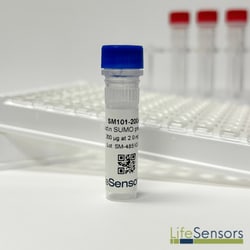
LifeSensors Biotin SUMO protein capture reagent 200µg
Small ubiquitin-like modifier (SUMO) proteins are a family of proteins that have a similar structure with ubiquitin. There are four SUMO genes in human genome. SUMO2 and SUMO3 are highly similar (97% identical), while SUMO1 is quite distinct from other members. SUMO4 contains a specific proline90 residue, which prevents it from being processed by SUMO protease. SUMOylation is a reversible post-translational modification that covalently attaches SUMO to target proteins. SUMOylation regulates many critical cellular processes, including replication, cell-cycle, protein transport and DNA repair. SUMO is essential for almost all the eukaryotes, and deregulation of SUMOylation leads to several diseases such as cancer and neurodegenerative diseases, necessitating SUMO research. The SUMO protein capture reagent, specifically recognizes SUMO proteins and is designed for detection, characterization, and isolation of SUMOylated proteins from cells and tissue extracts.


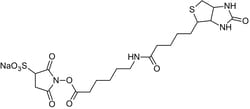
Abcam Sulfo-NHS-LC-Biotin, biotinylating reagent, 100MG
MW 556.6 Da, Purity >90%. Sulfo-NHS-LC-Biotin, biotinylating reagent. Achieve your results faster with highly validated, pure and trusted compounds.
The product is subject to the following: Abcam Restricted Use Statement

Abcam Biotinylation Kit / Biotin Conjugation Kit (Fast, Type B) - Lightning-Link, 1 mg, reaction time <20 min, hands-on time 30 sec, 100% antibody recovery, no purification needed
The Abcam Biotinylation Kit provides a rapid and efficient method for biotinylating antibodies and proteins, allowing for fast labeling in laboratory settings. With minimal hands-on time, this kit ensures total antibody recovery without the need for purification, making it ideal for various downstream applications including Western Blot, ELISA, and Immunohistochemistry.
- Biotin labeling in under 20 minutes
- Minimal hands-on time of 30 seconds
- 100% antibody recovery
- Targets primary amine groups like lysines
- Recommended antibody amount of 1 mg
- Maximum antibody amount of 2 mg
- Suitable for buffer pH of 6.5 to 8.5
- No purification required
- Compatible with Western Blot, ELISA, and IHC applications
- Ideal antibody concentration of 1 mg/mL
- Kit size of 1 mg
- Storage temperature of -20°C
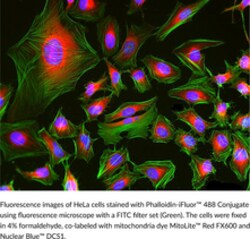
Cayman Chemical PhaloIdInIFluor488 Conjug
A fluorogenic dye used to label F-actin; ex/em spectra of 493/517 nm, respectively; can be used to label formaldehyde-fixed tissue, cells, and cell-free preparations for single- and multi-labeling purposes

Rockland Immunochemicals BIOTIN BETA GALACTOSIDASE Conjugated - B000-17
Biotin is a small biomolecule important for many cellular processes. Most importantly for biotechnology applications, biotin is ammenable to conjugation to proteins for use in biochemical assays. Biotin has a very strong affinity for avidin and streptavidin; an attraction that is the strongest and most stable non-covalent interaction known.Beta-galactosidase (beta-gal; β-gal) is an enzyme that hydrolyzes β-galactosides (such as lactose and various glycoproteins) into simple sugars. Beta-galactosidase is routinely used as a reporter in biochemical experiments as well as a marker for gene expression experiments in E. coli. Beta-galactosidase can be used to cleave the chemical X-gal that forms an intense blue product that can easily be quantified.

Cytoskeleton, Inc. Rhodamine Phalloidin, 1x500 ul
Purity >99.5%, Phalloidin's usefulness as a laboratory tool is well established and lies in it's ability to inhibit microfilament de-polymerization. Thus, phalloidin stabilized microfilaments are used as substrates for the identification and characterization of the ever increasing number of microfilament associated proteins. In addition, rhodamine phalloidin can be used for staining the actin cytoskeleton in cells, and also as a fluorescent marker/stabilizer for microfilaments used in motility assays. The rhodamine phalloidin is provided as a lyophilized powder. When reconstituted with 500 µl methanol, it is at 14 µM (200 x stock).


Jackson Immuno Research Labs Biotin-SP-ChromPure Human Transferrin
Biotin-SP-ChromPure Human Transferrin

Abcam Biotinylation Kit / Biotin Conjugation Kit (Fast, Type B) - Lightning-Link, 100UG
Biotin conjugation / labeling in < 20 mins with 30 secs hands-on time using Biotinylation Kit / Biotin Conjugation Kit (Fast, Type B) - Lightning-Link ab201796. 100% antibody recovery - Cited in over 15 publications - Biotin labeled antibody is ready for use in applications like WB, ELISA, and IHC, with no need for further purification - Compatible with most standard antibody formulations - Scalable;use the same conjugation method from 10µg-100mg of antibody - Use Lightning-Link conjugation with over 45 labels, including Alexa Fluor, DyLight, tandem dyes, enzymes, oligonucleotides, and gold nanoparticles
The product is subject to the following: Abcam Restricted Use Statement

Biolegend Avidin/Biotin Blocking System
Avidin/Biotin Blocking System Apps: IHC, WB; Size: 2 x 15 ml


Carbosynth LLC. Streptavidin Poly-HRP40 Conjugate for use in immunoassays
Streptavidin Poly-HRP Conjugate is streptavidin biotin-binding protein that is conjugated with polymers of horseradish peroxidase, enabling signal amplification and detection of biotinylated antibodies for IHC and other methods. This poly-HRP conjugate is designed to deliver the highest sensitivity and low background in immunoassays where sample volume is limited or when the target molecule is present at low levels. The estimated average number of HRP monomer molecules in SA-PolyHRP20 conjugate is 100 (20 X 5), in SA-PolyHRP40 - 200 (40 X 5) and in SA-PolyHRP80 - 400 (80 X 5). Thus, PolyHRP brings in reaction with substrate development system much larger number of enzyme label molecules (per one bound analyte molecule) than conventional conjugates do.